|
The Great War In Flanders - Ieper (Ypres) |
|||||
|
Page 3 |
|||||
|
The Westhoek & The Great War - Flanders Fields: |
|||||
|
Canal Bank - John McCrae Site: more pictures |
|||||
|
|||||
|
Mine Craters: more pictures |
|||||
The Mine Battle of 7th June 1917 was one of the most successful British operations during the war on the Western Front. Of the 19 large mines that were originally exploded, traces of 16 craters are still visible to this day, almost all in the shape of deep ponds.
Due to the proximity of the railway, this last crater is the only one in Flanders that is not filled with water. As of the middle of 2003, the mine crater at St Eloi can also be visited. This was the result of the largest depth mine detonated during the war. The mine crater, flanked by an intact British bunker from 1917, is located only 100 metres from another crater, the result of one of six mines exploded on 27th March 1916 during the "Attack on St. Eloi". |
|||||
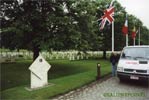 One
of the best known sites of the Ypres Salient is the "Essex Farm
Cemetery" and ADS (Advanced Dressing Station), where John McCrae
wrote his world-famous poem, "In Flanders Fields", on the 2nd
and 3rd May 1915.
One
of the best known sites of the Ypres Salient is the "Essex Farm
Cemetery" and ADS (Advanced Dressing Station), where John McCrae
wrote his world-famous poem, "In Flanders Fields", on the 2nd
and 3rd May 1915.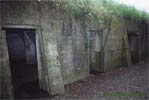 It is here that the 1st Canadian artillery brigade stood
in April 1915, and it was on this spot that shortly afterwards the Royal
Engineers built a number of shelters and dug-outs in the canal
bank.
It is here that the 1st Canadian artillery brigade stood
in April 1915, and it was on this spot that shortly afterwards the Royal
Engineers built a number of shelters and dug-outs in the canal
bank.  John
McCrae,
May 1915
John
McCrae,
May 1915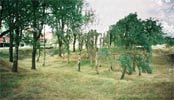 Until
recently only the "Lone Tree Crater" in Wijtschate, commonly
known as the "Pool of Peace", was open to the public. In
2001 the province also acquired the "Domein De Vierlingen",
which contains the "Caterpillar Crater", the counterpart of
the Hill 60 depth mine shown on the left.
Until
recently only the "Lone Tree Crater" in Wijtschate, commonly
known as the "Pool of Peace", was open to the public. In
2001 the province also acquired the "Domein De Vierlingen",
which contains the "Caterpillar Crater", the counterpart of
the Hill 60 depth mine shown on the left.