|
The
Great War In Flanders - Ieper (Ypres) |
|||
|
Page 1 |
|||
|
In 1914 hundreds of thousands of British were urged to take part in the Great War. It became a war far from home, a war overseas, somewhere in France. That part of the Western Front was actually a small piece of Belgium called the 'Westhoek'. The northern part of the Westhoek was relatively quiet in the Great War as in October 1914 the Belgian army halted the German attacks by flooding the plain of the river Yser (Ijzer). The Belgian army occupied the whole region from Nieuwpoort through Diksmuide up the canal to Ypres (Ieper). |
|||
|
Ieper (Ypres): more pictures |
|||
|
The
Ypres Salient is located in the southern part of the Westhoek. Wipers as Ypres was affectionately called by the British soldiers, and
the Salient around the old medieval city, was one of the most terrible
and infamous places from the Great War. In this area are villages
like Boezinge, Passendale, Messines, Pilkem, names recognised throughout
the world because of the battles fought on the ground almost 100 years
ago. Hundreds of thousands of soldiers lost their lives in this region alone. In and around Ypres half a million solidiers died, half of these from Great Britain and the Commonwealth. The majority of these names can be found in the dozens of military cemeteries and memorials throughout the Salient. Today, there are still names being added to the lists and bodies of soldiers being recovered to be placed in a corner of a foreign field that will remain forever England. The First World War almost completely destroyed this previously prosperous region of Belgium. Only Veurne, where the Belgian army had their headquarters escaped the violence of the war. |
|||
|
The Last Post: more pictures |
|||
The ceremony was begun in 1928. The buglers have perfomed ever since, though they were banned from playing during the German occupation of 1940-44. The Brookwood Barracks in England took over the ceremony during this period and on the first day of liberation in September 1944 it was reinitiated under the Menin Gate. For more information on this moving ceremony and for details of guest attendees and buglers please visit the Last Post Association here.
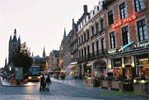
Reduced to rubble by constant bombardment, the town has come to symbolise the meaningless slaughter of the Great War. Now restored to its former glory, Ypres contains numerous poignant sites and monuments linked to the Great War. |
|||

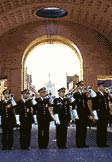 Every
evening at 8pm a ceremony takes place under the vast arch of the Menin
Gate: the traffic stops and buglers from the local fire brigade play
"The Last Post".
Every
evening at 8pm a ceremony takes place under the vast arch of the Menin
Gate: the traffic stops and buglers from the local fire brigade play
"The Last Post". 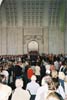
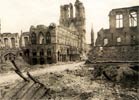 Ypres
was occupied by the German army for just one night at the beginning of
the Great War. It came under the control of Allied forces on 14th
October 1914. Around 5 million British and Commonwealth soldiers
passed through Ypres on their way to the Salient.
Ypres
was occupied by the German army for just one night at the beginning of
the Great War. It came under the control of Allied forces on 14th
October 1914. Around 5 million British and Commonwealth soldiers
passed through Ypres on their way to the Salient.